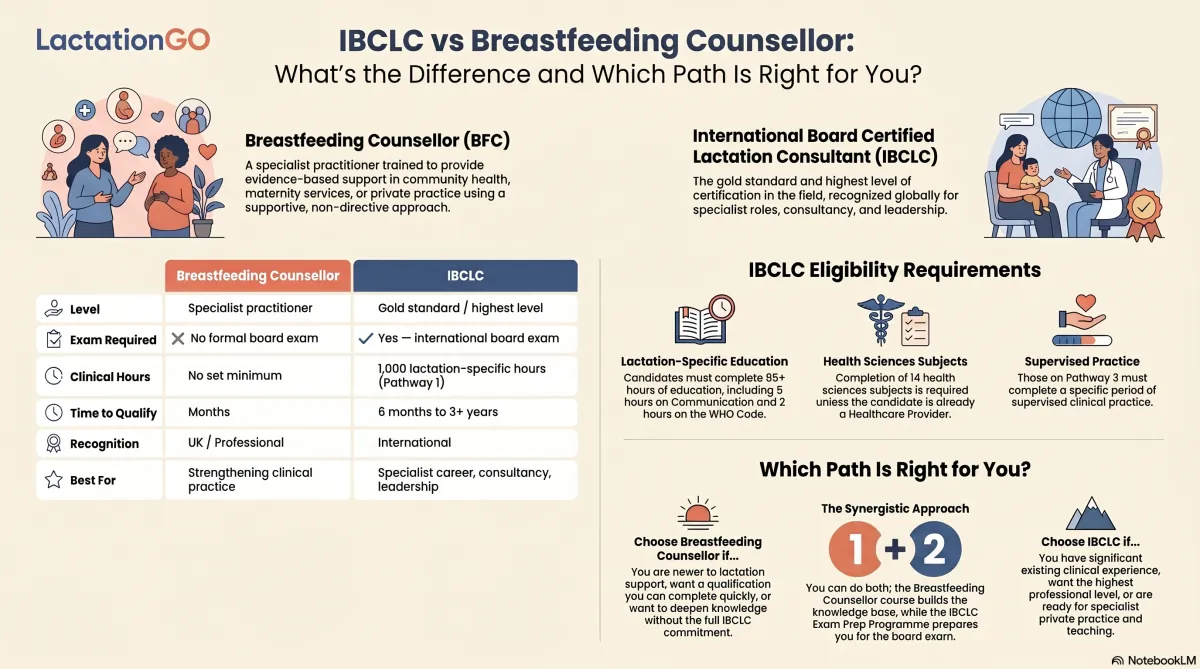
IBCLC vs Breastfeeding Counsellor: What's the Difference and which path is right for you?
IBCLC vs Breastfeeding Counsellor: What's the Difference and Which Path Is Right for Yo
If you've started looking into lactation training, you've probably come across both terms — breastfeeding counsellor and IBCLC — and wondered what the difference actually is. Are they the same thing? Is one better than the other? Do you need to do one before the other?
Let's clear it up, because the answer matters for how you plan your training and your career.
What is a Breastfeeding Counsellor?
A breastfeeding counsellor is a trained professional who provides evidence-based support to breastfeeding families. They understand the physiology of lactation, common feeding challenges, and how to help parents problem-solve in a supportive, non-directive way.
In the UK, breastfeeding counsellors can work in a range of settings — community health, maternity services, peer support programmes, or private practice. Training is typically shorter than the IBCLC pathway and is a brilliant entry point into specialist lactation work.
It's also valuable as a standalone qualification, particularly for healthcare professionals who want to significantly strengthen their clinical practice without committing to the full IBCLC route right now.
What is an IBCLC?
IBCLC stands for International Board Certified Lactation Consultant. It is the gold standard lactation qualification, the highest level of certification in the field, recognised globally.
To sit the IBCLC exam, you need to meet specific eligibility requirements set by the International Board of Lactation Consultant Examiners (IBLCE). These include 95+ hours of lactation-specific education (including 5 hours Communication and 2 hours WHO Code), a minimum number of lactation-specific clinical hours (currently 1,000 on Pathway 1), completion of 14 health sciences subjects (unless you are currently a Healthcare Provider), and a period of supervised practice (on Pathway 3).
The exam itself is rigorous and requires serious, focused preparation. But the credential it awards is internationally recognised and opens significant professional doors.
So what's the difference, in plain terms?
The simplest way to think about it is this: a breastfeeding counsellor is a specialist practitioner, while an IBCLC holds the highest level of qualification in the field. Becoming a breastfeeding counsellor doesn't require a formal board exam or a set number of clinical hours, and most people can complete their training in a matter of months. It's a UK-recognised professional qualification that's ideal for strengthening your day-to-day clinical practice.
The IBCLC route is a bigger commitment. It requires passing an international board exam, accruing 1,000 lactation-specific clinical hours (on Pathway 1), and depending on your starting point and how much time you have to study, the journey can take anywhere from six months to three or more years. In return, you gain a credential that's recognised internationally, the one to aim for if you're building toward a specialist career, private consultancy, or a leadership role in lactation.
Which one is right for you?
That depends on where you are right now and where you want to go.
Choose Breastfeeding Counsellor training if:
You want to deepen your lactation knowledge without the full IBCLC commitment
You're newer to lactation support
You want a qualification you can complete relatively quickly
You're building toward IBCLC and want a strong foundation first
Choose the IBCLC pathway if:
You have significant existing clinical experience in lactation
You want the highest level of qualification in the field
You're thinking about specialist roles, private practice, or teaching
You're ready to commit to a structured exam preparation process
Can you do both?
Yes, and for many people, that's exactly the right approach. The Breastfeeding Counsellor course builds the knowledge base; the IBCLC Exam Prep Programme takes you deeper and prepares you for the board exam.
At LactationGO, we offer both, and they're designed to work together.
The bottom line
Neither qualification is "better" — they serve different purposes and different career stages. What matters is choosing the path that matches where you are now and where you want to be.
If you're not sure, start by looking at your clinical hours and your career goals. And if you still want to talk it through, we're here.