From Midwife to IBCLC: How one qualification changed everything about the way I support families
From Midwife to IBCLC: How One Qualification Changed Everything About the Way I Support Families
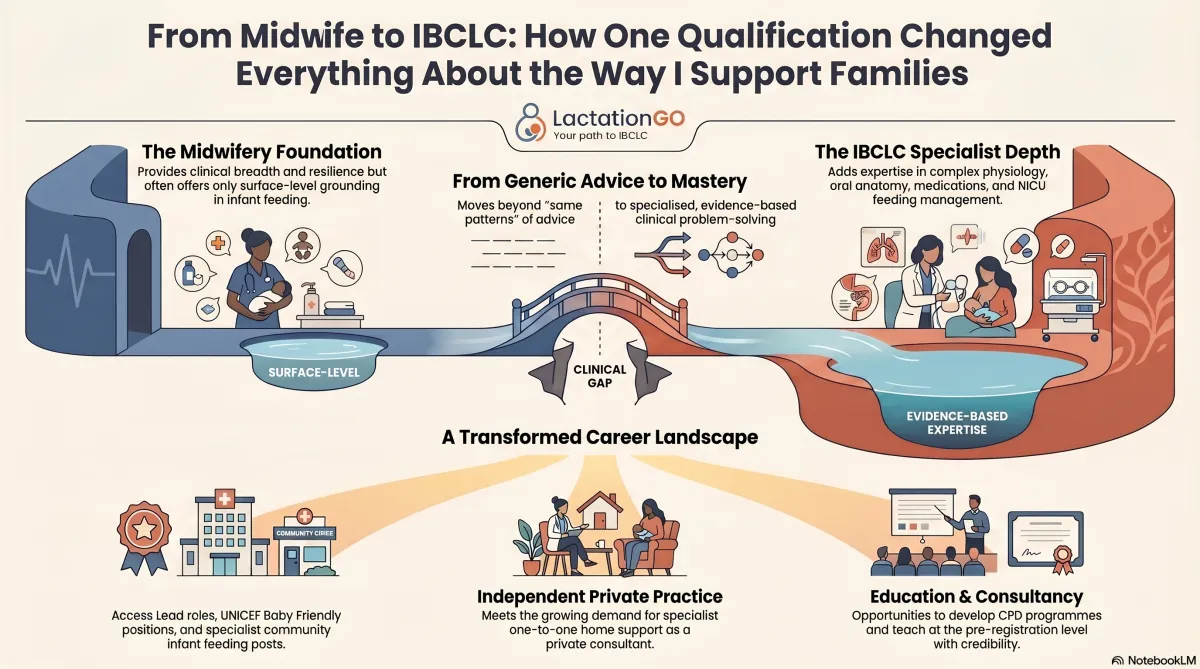
Midwifery gives you a lot. It gives you clinical breadth, resilience, adaptability, and an understanding of the perinatal period that very few professions can match. It also, if you're being honest about it, gives you a fairly surface-level grounding in infant feeding.
Not because midwifery education doesn't value breastfeeding — it does. But because there is so much to cover in pre-registration training, and lactation is a specialism in its own right. You can qualify as a midwife and feel genuinely underprepared for the complexity of what families actually experience in those first weeks.
That gap is exactly why so many midwives find their way to the IBCLC pathway.
The frustration that drives it
It usually starts with a specific moment. A family you couldn't help as well as you wanted to. A clinical situation you weren't sure how to manage. A parent who struggled and you didn't have the knowledge to turn it around.
Or sometimes it's more cumulative — a gradual awareness that you're seeing the same patterns over and over, giving the same generic advice, and not getting the outcomes families deserve.
Whatever the starting point, the underlying feeling is the same: I can do better than this, and I want to.
What the IBCLC adds to a midwifery background
The combination of midwifery training and the IBCLC credential is, genuinely, one of the most powerful in maternal and infant health. Here's why.
As a midwife, you already understand the physiology of the third stage, the hormonal landscape of the immediate postnatal period, the impact of birth interventions on early feeding, skin-to-skin contact, and the transition to extrauterine life. That knowledge doesn't disappear when you add an IBCLC qualification — it becomes the scaffolding that makes your lactation knowledge far more contextualised than it would be for someone without a clinical background.
The IBCLC adds depth in the areas where midwifery training is thinner — detailed lactation physiology, complex clinical problem-solving, medications and breastfeeding, oral anatomy, NICU feeding, and the evidence base that underpins all of it.
Together, they make you a clinician who can support families across the full spectrum of their experience — before, during, and after birth, through whatever challenges the feeding journey brings.
The career picture
For midwives with an IBCLC credential, the career landscape looks different.
In the NHS, there are specialist infant feeding roles that increasingly specify or prefer IBCLC status. UNICEF Baby Friendly work, infant feeding lead positions, and specialist community roles all become more accessible.
Beyond the NHS, private lactation consultancy is a growing sector. Parents increasingly want specialist one-to-one support at home, and IBCLCs are the qualification they seek out. For midwives wanting to move into independent practice, it's often the credential that makes that viable.
There are also opportunities in education: training other professionals, developing CPD programmes, teaching at pre-registration level. For midwives who enjoy the teaching side of practice, the IBCLC credential adds significant credibility in that space.
The personal dimension
It's worth acknowledging that for most midwives, this isn't purely a career calculation. It's personal. You came into midwifery because you care about families. You're pursuing the IBCLC because you want to care for them better.
That motivation matters. It's what keeps you going through the study, through the difficult weeks, through the moments when you wonder if it's worth it.
It is worth it. The families you'll support on the other side will feel the difference. So will you.
If you're a midwife considering the IBCLC pathway, LactationGO's Lactation Consultant (IBCLC) Preparation Course was designed with exactly your clinical background in mind. It covers the 95+ hours of lactation-specific education you need, including the 5 hours Communication and 2 hours WHO Code, and it is LEAARC-approved