How to Pass the IBCLC Exam First Time: A Revision Strategy That Actually Works
How to Pass the IBCLC Exam First Time: A Revision Strategy That Actually Works
The IBCLC exam is not easy. Anyone who tells you otherwise either hasn't sat it or has a very different definition of the word. It's a rigorous, clinically-focused board exam that tests not just your knowledge of lactation science, but your ability to apply it — quickly, accurately, and under pressure.
The good news? It's absolutely passable first time. Thousands of IBCLCs around the world do it every exam cycle. The difference between those who pass and those who don't usually isn't intelligence or clinical experience, it's how they prepared.
Here's what a revision strategy that actually works looks like.
Start with the IBLCE Exam Blueprint — and take it seriously
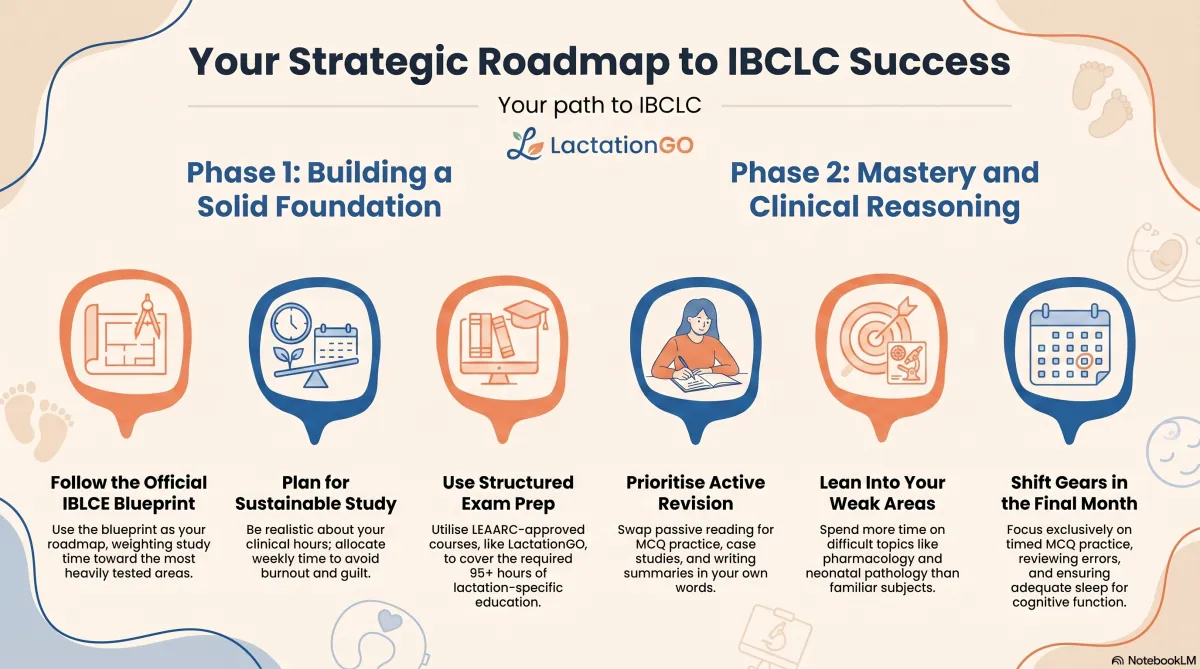
The IBLCE publishes a detailed exam blueprint that tells you exactly what content areas are covered and in what proportion. This is not a document to skim. It is your revision roadmap.
Every topic on the blueprint will appear in the exam. Some will appear more heavily than others. Build your study plan around the weightings, not just the topics that interest you or that you feel most confident in.
If you haven't already downloaded and read the blueprint carefully, do that before you do anything else.
Plan your time realistically
Most candidates preparing for the IBCLC exam are also working — often full-time, in clinical roles, with everything else that life involves. Pretending you're going to study for three hours every evening is a fast route to burnout and guilt.
A realistic, sustainable study plan is far more effective than an ambitious one you abandon after two weeks.
Work out how many weeks you have before the exam. Be honest about how many hours per week you can genuinely commit to. Then allocate those hours across the content areas, weighting toward the areas that carry more marks and the areas where you currently feel least confident.
Build in rest. Build in review weeks. Plan for things to come up, because they will.
Active revision beats passive reading every time
Reading a textbook is not studying. It feels productive, but passive absorption of information rarely sticks the way you need it to for a board exam.
Active revision means:
Testing yourself regularly — MCQ practice is non-negotiable. Do it from early in your preparation, not just in the final weeks.
Writing summaries in your own words — if you can't explain a concept clearly, you don't know it well enough yet.
Working through case studies — the IBCLC exam is heavily case-based. Practising clinical reasoning is as important as knowing the facts.
Making connections — understanding why something happens (the physiology, the mechanism) makes it far easier to apply knowledge in unfamiliar clinical scenarios.
Know your weak areas and lean into them
Most candidates have areas they're less comfortable with. Common ones include pharmacology and medications in lactation, neonatal pathology affecting feeding, and the more detailed aspects of breast anatomy and physiology.
It's human nature to spend more time on what you already know — it feels more rewarding and less threatening. Fight that instinct. Allocate more time to the areas you find difficult, not less.
Use a structured exam prep programme
Trying to assemble your own study materials from scratch is time-consuming and often results in gaps. A good Lactation-Specific Course gives you a clear structure, ensures you cover all the content areas in appropriate depth, and typically includes MCQ banks and case studies that mirror the format of the real exam.
It also keeps you accountable, which, if you're studying independently around a busy clinical life, is not a small thing.
At LactationGO, our Lactation Consultant (IBCLC) Preparation Course is built around exactly this approach. It covers all content areas in the IBLCE blueprint, includes extensive MCQ practice, as 3 practice exams, and is designed to build clinical reasoning skills, not just rote knowledge. It covers the 95+ hours of lactation-specific education you need, including the 5 hours Communication and 2 hours WHO Code, and it is LEAARC-approved
In the final four weeks — shift gears
The final month before the exam is not the time to start learning new content. It's the time to consolidate, practise, and build confidence.
Focus on:
High-volume MCQ practice under timed conditions
Reviewing anything you consistently get wrong
Going back to the exam blueprint and checking you've covered everything
Getting enough sleep (genuinely — cognitive function matters)
On exam day
Read every question carefully. IBCLC questions are often testing your ability to identify the best answer, not just a correct one. Pay attention to what the question is actually asking.
Trust your preparation. If you've put in the work, you know more than you think you do in the room.
You can pass this exam first time. It takes planning, consistency, and the right support. All of those things are available to you.
[Explore the LactationGO Lactation Consultant (IBCLC) Preparation Course →]