How Midwives, Health Visitors and Neonatal Nurses Are Upskilling in Lactation (And Why It Matters)
How Midwives, Health Visitors and Neonatal Nurses Are Upskilling in Lactation (And Why It Matters)
Breastfeeding rates in the UK remain stubbornly low. We know this. The research is clear that the majority of parents who stop breastfeeding earlier than they wanted to do so because they didn't get the right support at the right time.
That support, or lack of it, almost always comes down to the professionals in the room.
Which is exactly why more midwives, health visitors, and neonatal nurses are choosing to invest in specialist lactation training. Not because it's a tick-box exercise, but because they've seen firsthand what inadequate support looks like, and they want to be part of the solution.
The gap between intention and support
Most parents in the UK want to breastfeed. The initiation rates are actually pretty good. The drop-off in the early weeks, though, that's where the system fails them.
Often, it's not a failure of care or compassion. It's a failure of knowledge. Healthcare professionals who genuinely want to help are working with limited training, limited time, and outdated information. They give the advice they were taught to give, which isn't always the evidence-based advice that actually solves the problem.
Specialist lactation training changes that.
What upskilling actually looks like in practice
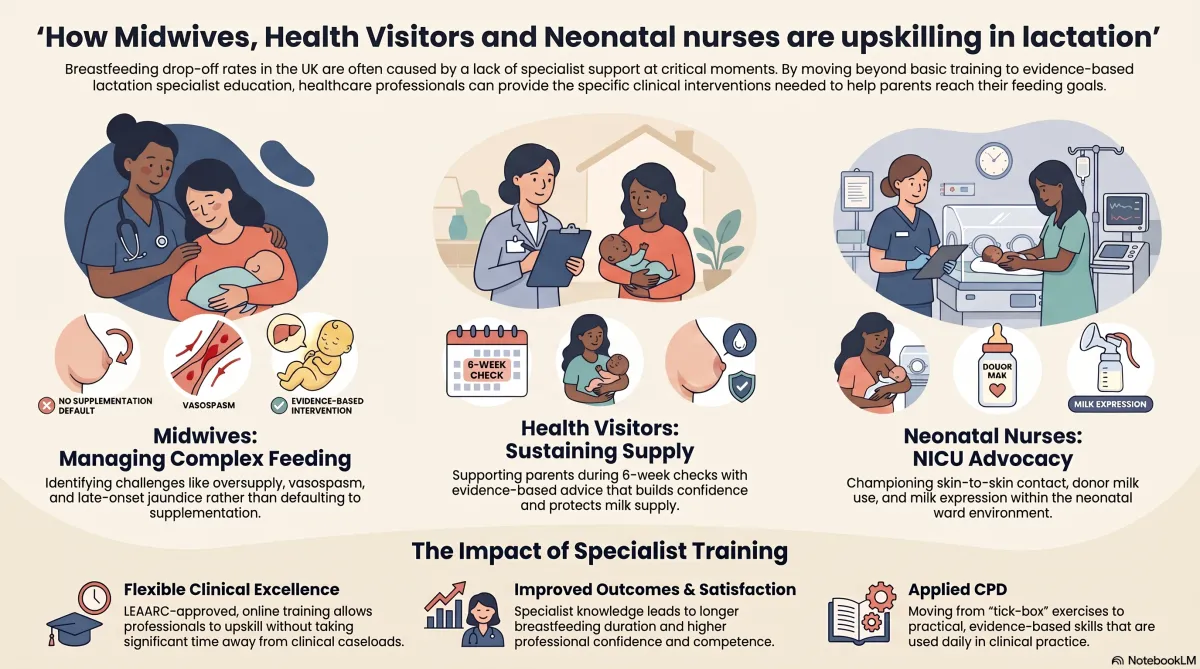
For a Midwife, it might mean being able to identify and manage complex feeding challenges — oversupply, vasospasm, late-onset jaundice affecting feeding — rather than defaulting to "just supplement for now."
For a Health Visitor, it means having the knowledge to support a mother at the 6-week check who's struggling with supply, rather than inadvertently undermining her confidence with well-meaning but unhelpful advice.
For a Neonatal Nurse, it means understanding the evidence around donor milk, skin-to-skin, and milk expression in the NICU context — and being able to advocate for families on the ward.
The difference isn't just clinical. It's the difference between a parent feeling supported and a parent giving up.
Why now is a good time to train
Online, flexible lactation training has made it genuinely possible to upskill without taking significant time away from clinical work. You no longer have to choose between developing professionally and keeping up with your caseload.
At LactationGO, our courses are built specifically for busy healthcare professionals. The Lactation Consultant Course is LEAARC-approved, evidence-based, and designed to fit around the reality of clinical life, not the idealised version of it.
CPD that actually means something
It's easy to fill your CPD hours with things that feel useful in the moment but don't really change how you practice. Lactation training is different. It's applied. You will use it the next day. And the day after that.
For health visitors especially, who often have the most contact with new families in the early weeks, specialist lactation knowledge is arguably one of the highest-impact CPD investments you can make.
The professionals who are already doing this
Across the UK, midwives and health visitors are completing lactation training and describing it as one of the most clinically valuable things they've done. Not because it's fashionable. Because it works.
Families get better support. Breastfeeding duration improves. And the professionals providing that support feel more confident, more competent, and more satisfied in their roles.
That's not a small thing.
If you're a midwife, health visitor, or neonatal nurse thinking about taking the next step in lactation, we'd love to help you get there.
[Explore LactationGO's lactation training →]