From Nanny to IBCLC: How to Get From A to B and How It Will Transform Your Job Prospects
From Nanny to IBCLC: How to Get From A to B and How It Will Transform Your Job Prospects
On the surface, nannying and lactation consulting might seem like an unusual combination. But spend a moment thinking about the reality of what a nanny actually does, and the connection becomes obvious.
You are, in many cases, the most consistent adult presence in a new family's life during the fourth trimester. You're there in the feeds at 2am. You're the one a new mother turns to at 7am when she's exhausted and sore and wondering if she's doing it wrong. You see the full picture of how that family is functioning — and how the feeding is going — in a way that no GP, midwife, or health visitor ever will.
That position comes with an enormous amount of potential influence. And right now, most nannies are exercising that influence with very limited formal knowledge of lactation.
That's the gap the IBCLC can fill.
Why the IBCLC pathway is worth considering seriously
The IBCLC is the gold standard lactation qualification in the world. It's internationally recognised, clinically rigorous, and carries genuine professional weight. For a nanny, it's also, and this is worth saying plainly, a significant commercial differentiator in a competitive market.
Families who are committed to breastfeeding actively look for support professionals who can provide specialist help. A nanny who can offer that, formally and credibly, is not the same as one who can't. The market reflects that, and we'll come to the practical implications in a moment.
But first, let's be clear-eyed about the pathway, because it is longer without a healthcare background, and you deserve a straight picture of what's involved.
Getting from A to B: what the pathway looks like for a nanny
The prerequisites:
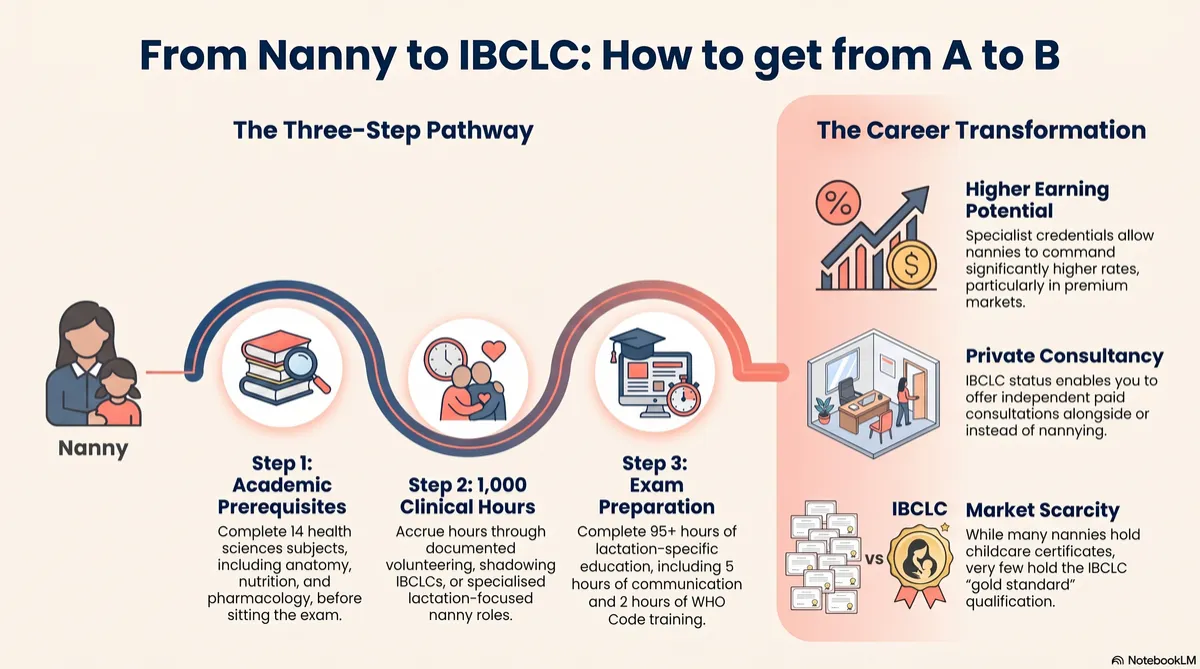
IBLCE requires candidates to demonstrate completion of 14 health sciences subjects before sitting the exam. These cover areas like anatomy and physiology, nutrition, psychology, pharmacology, and human development.
Unlike healthcare professionals, most nannies won't have covered these through prior training. That means you'll need to complete them independently. Many are available through online courses — some free, some low-cost — and some IBCLC exam prep providers offer guidance on how to satisfy the prerequisites efficiently (LactationGO does exactly this).
This is manageable, but it requires planning. Do this audit at the start of the process, not six months in.
The clinical hours:
The IBCLC pathway requires 1,000 documented lactation-specific clinical hours. For nannies, this is the most significant logistical challenge on the pathway.
Hours accrued in a nanny role may count toward this total if the contact genuinely involves lactation support, but the nature and documentation of those hours needs to meet IBLCE's criteria. Working closely with breastfeeding families is relevant; doing the school run is not.
To build your hours more systematically, consider:
Working alongside a qualified IBCLC or in a setting where they practice
Volunteering with breastfeeding charities or peer support organisations (with appropriate documentation)
Seeking nanny positions specifically with breastfeeding families where lactation support is part of the role
Building your hours takes time and intentionality, but it's entirely achievable over time, with focused effort.
Exam preparation:
This is where the investment of time and money comes in, and it's worth doing properly. The IBCLC exam is rigorous and wide-ranging. A good exam prep programme structures your study, ensures you cover all content areas, and gives you the practice MCQs and case studies you need to approach the exam with confidence.
LactationGO's Lactation Consultant (IBCLC) Preparation Course is fully online and built for people studying around a working life. It covers the 95+ hours of lactation-specific education you need, including the 5 hours Communication and 2 hours WHO Code, and it is LEAARC-approved.
You don't need a clinical placement to study, you need commitment and a good programme.
How IBCLC status transforms your job prospects as a nanny
Let's be direct about this, because it's genuinely significant.
You become the candidate families specifically seek out. Families committed to breastfeeding, and there are many of them, are actively looking for support professionals with lactation credentials. When an IBCLC-qualified nanny comes up in a search, that's not just a nice-to-have. For the right family, it's exactly what they've been looking for.
Your earning potential increases substantially. Nannies with specialist qualifications command higher rates. IBCLC is one of the most distinctive credentials you can hold in the early years space — it's unusual, it's valuable, and it's compensated accordingly. In premium positions and in London and the south-east particularly, the rate differential for a demonstrably specialist nanny is meaningful.
You can expand into private lactation consultancy alongside nanny work. IBCLC status enables you to offer paid lactation consultancy services independently — home visits, virtual consultations, ongoing support for families you're not working with full-time. For nannies who want to build a portfolio career or transition out of live-in or full-time work, this is a real and growing income stream.
You stand out in an increasingly crowded market. The nanny market is competitive. Qualifications matter. And while many nannies hold childcare certificates, Norland qualifications, or first aid training, almost none hold an IBCLC. That scarcity is an advantage.
A note on the journey
It would be dishonest to suggest this is a quick or simple pathway without a healthcare background. It isn't. It requires planning, sustained effort, and financial investment in training and exam fees.
But the families you'd be supporting, particularly those navigating the complexity of establishing breastfeeding while also managing a new baby, a return to work, and everything else that comes with early parenthood, genuinely need people with this level of knowledge.
If you work with families because you care about getting it right for them, the IBCLC is the qualification that reflects that.
[Explore the LactationGO Lactation Consultant (IBCLC) Preparation Course →]