World Breast-feeding Week 2026: Why Sustainable Support Systems start with us
World Breastfeeding Week 2026: Why Sustainable Support Systems Start With Us
1–7 August 2026
Every August, the lactation world pauses to mark World Breastfeeding Week (WBW) — a global campaign coordinated by the World Alliance for Breastfeeding Action (WABA), alongside WHO and UNICEF, since 1992. This year it runs from Saturday 1st to Friday 7th August, and the 2026 theme is one that speaks directly to everyone training with LactationGO right now:
"Prioritise Breastfeeding: Create Sustainable Support Systems."
It's a theme that moves the conversation on from awareness to infrastructure. Not "let's talk about breastfeeding for a week," but "let's build the systems that make breastfeeding support available every week, for every family, for years to come." And that's exactly where trained practitioners come in.
What "sustainable support systems" actually means
WABA's framing this year centres on tracking progress and evaluating breastfeeding's impact on nutrition, food security, and poverty reduction — looking at what's worked, what hasn't, and where the gaps remain. WHO and UNICEF have used the week to call attention to a stark fact: only a fraction of countries currently include infant and young child feeding training as a standard part of education for the doctors and nurses caring for new mothers. That means most new parents are leaving hospital without proper guidance on breastfeeding, or on when and how to introduce complementary feeding.
Read that again. It's not a knowledge problem — breastfeeding science is well established. It's a workforce problem. There simply aren't enough properly trained people sitting between exhausted new parents and good information.
That gap is the entire reason CPD-accredited and IBCLC-track training exists. Sustainable support systems aren't built from one good campaign week. They're built one trained midwife, health visitor, doula, neonatal nurse, and maternity nurse at a time — each one able to walk into a ward, a home visit, or a video call and actually know what they're doing.
What this means if you're training with us
If you're working through the Breastfeeding Counsellor Course or the IBCLC Exam Prep Course this year, WBW 2026 is a good moment to reframe what your CPD hours are actually for. You're not just collecting certificates — you're becoming part of the "Warm Chain of Support" that WABA talks about: the connected, reliable network of people a breastfeeding parent should be able to reach at any stage, in any setting, without the support depending on luck or postcode.
A few ways that shows up in practice:
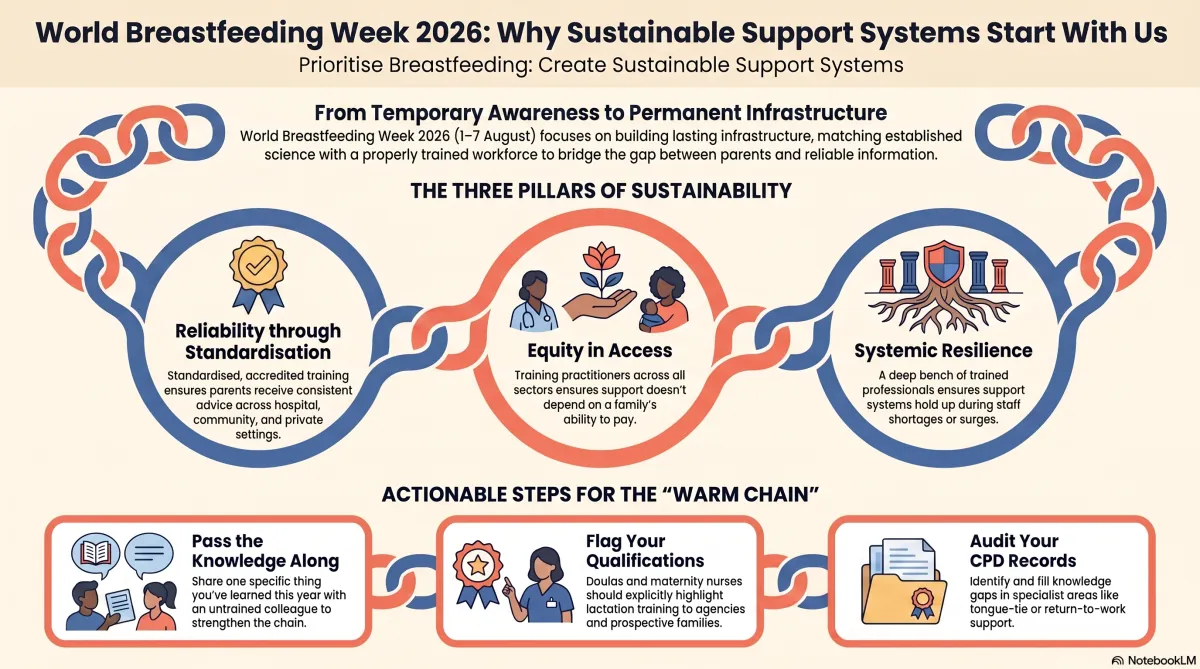
Reliability — a parent should get consistent advice whether they're talking to a hospital midwife, their health visitor, or a private lactation consultant. Standardised, accredited training is what makes that consistency possible.
Equity — support shouldn't depend on whether a family can afford private help. The more practitioners trained across NHS, community, and private settings, the wider that net.
Resilience — support systems need to hold up under pressure (staff shortages, winter surges, public health emergencies). That only happens if there's a deep enough bench of trained people to draw on.
Marking the week yourself
You don't need a huge campaign to take part meaningfully. A few ideas that fit naturally into what you're already doing:
Share one thing you've learned this year with a colleague who isn't yet trained in lactation support — pass the knowledge along the chain.
If you're nanny, doula, or maternity-nurse trained, use the week to flag your qualification to agencies or families who might not know to ask for it.
Use the week as a prompt to look at your own CPD record — are there gaps in tongue-tie, flange sizing, or returning-to-work support worth filling before your next recertification cycle?
World Breastfeeding Week ends on the 7th. The support systems it's asking us to build don't.
Training with LactationGO? However you mark WBW 2026, know that every module you complete is part of the system WABA is asking the world to build. That's not a small thing.